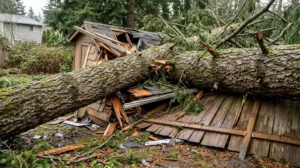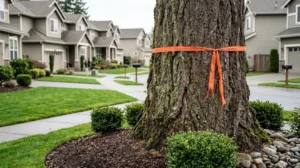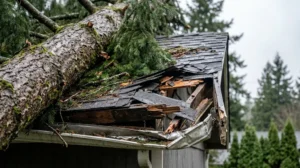

A Douglas fir is dying or at imminent risk of falling if it displays reddish-brown needle discoloration progressing downward from the crown, red-orange boring dust in bark crevices from Douglas-fir beetles, bracket fungi along the root flare, or soil mounding indicating root plate lifting. In Western Washington, structural root rot pathogens like Coniferiporia sulphurascens frequently cause catastrophic windthrow during 45+ mph Puget Sound winter storms while the tree’s upper foliage remains completely green.
Recognizing the biological and mechanical warning signs early prevents severe structural damage, utility disruptions, and emergency crane extractions.
Douglas Fir Hazard Diagnostic Matrix
Use this reference table to evaluate visual symptoms, underlying biological causes, and failure probabilities on your property.
| Visual Symptom | Primary Biological / Physical Cause | Structural Threat Level | Required Action Protocol |
| Cinnamon-Brown / Red Needles Across Entire Upper Crown | Douglas-fir Beetle (Dendroctonus pseudotsugae) or vascular girdling | Extreme / Imminent Mortality | Immediate ISA arborist hazard assessment; rapid removal to stop beetle dispersal |
| Heavy “Distress Crop” of Small Cones at Tree Tip | Advanced Root Disease / Severe Vascular Stress | High | Inspect root plate for fungal conks; schedule stability testing |
| Fine Reddish-Orange Frass in Bark Crevices & at Base | Active Bark Beetle Boring into Cambium Layer | Critical | Check sapwood for beetle galleries; tree cannot survive complete girdling |
| Soil Mounding or Fresh Soil Cracking on Uphill Side of Lean | Active Root Plate Lifting / Mechanical Anchorage Failure | Immediate Emergency | Evacuate impact zone immediately; emergency crane-assisted removal |
| Brown Shelf Fungi (Conks) on Lower Trunk or Exposed Roots | Velvet-Top Fungus (Phaeolus schweinitzii) or Red Ring Rot | High / Severe Windthrow Risk | Perform sonic tomography or resistance micro-drilling to measure sound wood |
| Sparse, Chlorotic (Pale Green/Yellow) Needles on Lower Branches | Swiss Needle Cast (Nothophaeocryptococcus gaeumannii) or shade competition | Low to Moderate | Fungicidal management or crown thinning; rarely triggers catastrophic failure |
| Oozing White/Clear Resin Streams Along Mid-Trunk | Defensive Pitch Exudation (Beetle or Canker Attack) | Moderate to High | Monitor crown for needle fade; tree is expending reserves fighting attack |
Crown Symptoms: Needles, Leaders, and Stress Signals
The canopy of a Douglas fir (Pseudotsuga menziesii) provides the clearest indicator of systemic vascular health. A healthy mature fir maintains dense, dark blue-green foliage distributed evenly across its upper and middle live crown.
1. Rapid Foliage Fading and Needle Cast
When a Douglas fir suffers vascular failure, its needles lose chlorophyll in a distinct progression:
- Chlorosis: Needles turn pale yellowish-green across several large branch whorls.
- Red-Top Syndrome: Needles turn bright cinnamon-red to reddish-brown, starting at the central leader and moving downward.
- Needle Shedding: Within 12 to 18 months following vascular death, needles shed completely, leaving bare gray twigs.
According to the Washington State Department of Natural Resources Forest Health Division, conifer crowns killed by bark beetles or abrupt root loss often do not turn visibly red until the summer after the initial fatal attack occurred. If a mature fir shows widespread red foliage during warm summer months, the tree is dead.
2. The Distress Cone Crop
A Douglas fir undergoing severe biological stress frequently produces an abnormally dense, heavy cluster of undersized cones at the very tip of its central leader. This phenomenon, known as a distress cone crop, represents an evolutionary survival mechanism: the tree diverts its remaining carbohydrate reserves into seed production before vascular flow collapses completely. A heavy cone crop on a thinning, pale crown indicates advanced root failure or trunk girdling.
3. Dead Leaders and Top Dieback
A dead, leafless top (“spike top”) signals that the tree’s root system or vascular cambium can no longer pump water 80 to 120 feet into the air. Spike tops often result from severe summer drought cycles, root damage from utility trenching, or secondary canker infections. A dead leader will eventually decay, fracture, and drop straight down during winter windstorms.
Bark and Trunk Indicators: Beetles and Mechanical Fractures
External trunk symptoms reveal internal structural damage and active insect infestations that undermine timber strength.
1. Douglas-Fir Bark Beetle Signs
The Douglas-fir beetle is the most destructive native insect targeting mature firs in South King County. As detailed in the USDA Forest Service Douglas-fir Beetle Guide, beetles preferentially attack trees stressed by root rot, recent clearing, or summer drought.
- Boring Dust (Frass): Female beetles bore through bark crevices to lay eggs in the phloem. This generates fine, reddish-orange boring dust resembling coarse cinnamon that accumulates in bark furrows, spider webs, and around the root flare.
- Pitch Streams: Stressed but living trees attempt to pitch out invading beetles, creating streams of clear or white resin flowing down the upper and middle trunk.
- Woodpecker Flaking: Heavy woodpecker activity that strips exterior bark plates to reach beetle larvae exposes underlying inner bark and signals advanced infestation.
2. Vertical Cracks and Included Bark
- Frost and Drought Cracks: Long, vertical seams that split the bark and penetrate the underlying sapwood expose the tree to wood-decaying fungi.
- Co-Dominant Stems: Douglas firs that split into two or three primary trunks with “V-shaped” unions feature included bark. As both trunks expand, the bark wedged between them prevents wood fibers from knitting together, creating a severe failure point that splits open under snow loads or high winds.
Root Plate and Basal Decay: The Hidden Anchoring Threat
Root diseases represent the most dangerous structural hazard in Western Washington because they destabilize 10,000-pound trees while the upper crown remains full, green, and apparently healthy.
1. Laminated Root Rot (Coniferiporia sulphurascens)
Laminated root rot is the single most common cause of windthrow in Western Washington conifer stands, according to WSU Extension Forestry.
- The fungus attacks and dissolves the structural lignin within the tree’s anchoring roots.
- Infected wood separates along annual growth rings into distinct sheets (laminae), spotted with small oval pits and cinnamon-colored fungal whiskers.
- Affected roots snap off cleanly near the base, creating a “root ball” stripped of anchoring tendrils. When hit by strong winds, trees with laminated root rot fail without warning at ground level.
2. Velvet-Top Fungus (Phaeolus schweinitzii)
Velvet-top fungus causes severe brown cubical butt rot in mature Douglas firs. The fungus enters through fire scars, mower scrapes, or mechanical roots cuts, consuming internal cellulose in the lower six to eight feet of the trunk.
- Look for circular, velvety brown fruiting bodies (conks) that resemble cow pies growing on the ground directly above lateral roots or protruding from the base of the trunk.
- A hollow or brittle base causes the tree to snap cleanly across the trunk cylinder during moderate storms.
3. Soil Heaving and Basal Mounding
If a leaning Douglas fir shows fresh ground mounding, sheared sod, or crescent-shaped soil cracks on the side opposite its lean, the root plate has begun pulling out of the ground. This is an active mechanical failure. Saturated soils eliminate remaining friction, and the tree can collapse under its own weight at any moment without wind.
Western Washington Environmental Risk Amplifiers
Tree failure rates in Kent and South King County are driven by distinct geological and weather dynamics:
- Glacial Till and Hardpan Layers: Glacial till across Kent East Hill and West Hill plateaus features dense, compacted hardpan 18 to 36 inches beneath topsoil. Douglas firs cannot penetrate this barrier, forcing them to develop wide, pancake-flat root systems rather than deep taproots.
- Rainfall Saturation: Western Washington receives roughly 40 inches of annual precipitation, with 75% falling between October and March. Extended atmospheric river storms fully saturate the soil, converting firm ground into loose mud and reducing root plate holding capacity by up to 50%.
- Green River Valley Wind Corridors: Sustained southerly gusts funneling up the valley floor frequently exceed 50 mph. When these high winds strike saturated root plates, firs with asymmetric crowns or compromised roots suffer immediate windthrow.
What to Do If You Suspect Your Douglas Fir Is Compromised
If your Douglas fir exhibits two or more critical hazard markers, follow these verification steps:
- Evacuate the Target Zone: Keep vehicles, outdoor furniture, and family members away from the fall radius (a circle matching the total height of the tree).
- Book an ISA TRAQ Arborist Assessment: Hire an arborist certified in Tree Risk Assessment Qualification. The arborist uses sound-testing mallets, digital resistographs, or sonic tomograms to measure internal solid wood thickness without harming the tree.
- Verify City of Kent Regulations: If the tree requires removal, determine whether it falls within Kent Municipal Code Chapter 11.06 (Environmentally Critical Areas) or requires an emergency hazard verification filing.
Protect Your Property from Tree Failure
A structurally compromised Douglas fir poses an immense physical threat to your roof, garage, utility lines, and family safety. If a large evergreen on your property is dropping red needles, exuding pitch, leaning toward a structure, or displaying fungal conks around its base, reach out through our contact page to schedule an immediate on-site hazard evaluation and safe removal plan with Kent Tree Removal.