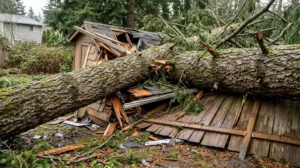
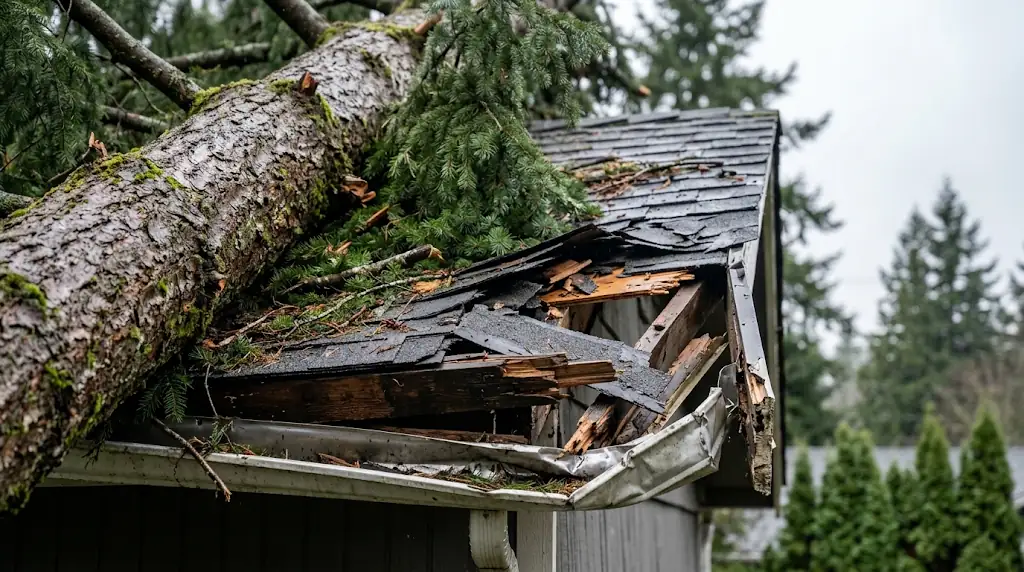
If a tree falls on your house in Kent, WA, immediately evacuate all occupants from the impact zone, check for injuries, and call 911 if there is structural collapse or downed power lines. Once everyone is safe and utilities are evaluated, contact your homeowners insurance company to file an emergency claim and dispatch a licensed, 24/7 tree removal service equipped for crane-assisted extractions and structural tarping.
Never climb onto the roof or attempt to cut fallen timber under tension yourself. Secondary shifts, live electrical currents, and compromised framing make fallen trees on residential structures an immediate life-safety hazard.
Emergency Action Protocol: The First 60 Minutes
When a mature conifer hits a roof, time-sensitive actions prevent further structural collapse, personal injury, and insurance dispute delays.
| Timeframe | Priority Action | Responsible Entity / Contact | Key Objective |
| Minutes 0 – 5 | Evacuate impact zone; call 911 for injuries/fires | Puget Sound Fire / 911 | Life-safety verification, structural sweep |
| Minutes 5 – 15 | Inspect for downed wires and gas leaks | Puget Sound Energy (PSE) (1-888-225-5773) | De-energize active electrical or gas hazards |
| Minutes 15 – 30 | Take wide-angle and close-up photographic evidence | Property Owner | Full claim documentation prior to cleanup |
| Minutes 30 – 45 | Contact insurance carrier to report emergency loss | Homeowner’s Insurance Carrier | Open claim, obtain emergency reference number |
| Minutes 45 – 60 | Dispatch an emergency tree removal crew | Licensed Tree Contractor | Rigging, crane extraction, weatherproofing |
Step 1: Evacuate the Impact Zone and Check for Injuries
The sound of a tree striking a home resembles an explosion. Shock waves travel through structural trusses, cracking drywall, shattering glass, and shifting load-bearing exterior walls.
- Clear the Immediate Vicinity: Evacuate everyone out of rooms directly underneath or adjacent to the impact point. Ceilings can collapse minutes or hours after initial impact under the sustained deadweight of timber.
- Assess for Structural Shifting: If the tree pierced the roof deck, penetrated an upper floor, or buckled exterior walls, evacuate the entire house immediately.
- Call 911 for Collapse or Trapped Individuals: Puget Sound Fire provides emergency technical rescue and structural stabilization across the City of Kent, Covington, and SeaTac. Request emergency fire response if anyone is injured or if structural integrity is compromised.
Step 2: Neutralize Electrical, Gas, and Water Hazards
A fallen tree rarely damages only shingles. Branch impacts routinely sever electrical service masts, rip gas meters off foundations, and fracture domestic plumbing lines.
Electrical Line Hazards
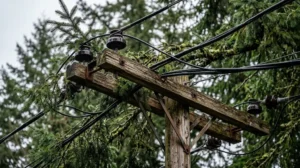
If the falling tree brought down overhead power lines or snapped your home’s private service mast, the ground, metal fencing, and gutter systems may carry live electrical current.
- Stay at least 35 feet away from any downed wire or tree limb touching utility cables.
- Do not touch metal chain-link fences or aluminum siding connected to the impact area.
- Call Puget Sound Energy immediately at 1-888-225-5773 or 911 to report downed electrical lines. PSE must disconnect power at the street pole before any crew or homeowner approaches the tree.
Natural Gas and Plumbing Lines
- Check for the scent of sulfur or hissing noises around the perimeter of the home.
- If you smell natural gas, shut off the main valve only if it is completely safe to do so, move uphill/upwind, and report the leak immediately.
- If internal water pipes ruptured, shut off your main home water shutoff valve to stop interior water damage.
Step 3: Document the Scene Before Anything Moves
Insurance companies require clear visual documentation to substantiate total loss, structural damage, and debris removal payouts. Do not move branches or discard broken property until the scene is recorded.
- Capture Wide Exterior Angles: Photograph all four sides of the home showing the tree’s orientation, the trunk’s base, and the damaged roofline.
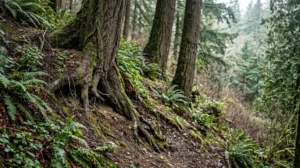
- Photograph the Root Plate: Take high-resolution images of the root system or stump. Proving whether the tree broke due to extreme windthrow or failed due to pre-existing basal rot determines liability—especially if the tree originated on a neighbor’s parcel.
- Document Interior Infiltration: Photograph cracked rafters, water leaking through ceilings, damaged personal property, and displaced insulation.
- Record Video Walkthroughs: Record a narrated video documenting ambient weather conditions, the extent of structural sagging, and water dripping through the ceiling.
Step 4: Mitigate Secondary Damage (Weatherproofing and Tarping)
Under standard property insurance policies governed by the Washington State Office of the Insurance Commissioner, homeowners maintain a contractual duty to mitigate secondary damage once life-safety risks are cleared.
Western Washington’s climate guarantees that an exposed roof hole will funnel gallons of rain into home interiors within hours:
- Install Heavy-Duty Polyethylene Tarps: Once the hazardous weight is lifted from the roof structure, install commercial-grade 10-mil waterproof tarps over all breached roof planes.
- Secure With Wood Battens: Never use bricks or loose sandbags to hold tarps on pitch lines. Screw 1×2 wood lath strips through the tarp perimeter into solid decking to resist Puget Sound storm winds.
- Retain All Receipts: Keep every invoice for tarps, plywood board-ups, and specialized mitigation materials. These emergency stabilization expenses qualify for reimbursement under the reasonable repairs clause of your policy.
Step 5: How Homeowners Insurance Handles Tree Removals in Kent
Understanding how insurance carriers handle storm damage claims prevents unexpected out-of-pocket expenses:
Structural Damage vs. Ground Debris
If a tree falls on your dwelling, garage, or permitted outbuilding, your policy’s Dwelling Coverage (Coverage A) pays to repair the roof, trusses, and interior damage, subject to your policy deductible.
However, tree removal itself is typically split into two cost buckets:
- Extraction Off the Structure: The labor, rigging, and crane operations required to lift the heavy log off the house are covered under dwelling structural repairs.
- Debris Hauling and Disposal: Once the tree is placed on the ground, policies frequently cap yard debris removal at a specific sublimit—often $500 to $1,000 per tree.
What If It Was Your Neighbor’s Tree?
If a neighbor’s tree falls onto your house during a storm, you still file the claim through your own insurance company. In Washington State, severe storms are legally considered an “Act of God.”
Your insurer will cover your structural repairs unless you can demonstrate prior negligence. If you previously delivered a written ISA arborist assessment via certified mail warning the neighbor of the tree’s hazardous, rotting condition, your insurer will subrogate the claim to recover your deductible directly from the neighbor’s carrier.
Kent Municipal Permitting Rules for Emergency Removals
Homeowners frequently ask if they must wait for city permits before removing a tree that crushed their roof.
The City of Kent Public Works Department and Planning Division allow immediate emergency abatement when a tree poses an imminent threat to life or occupied structures:
- Zero Permitting Delays for Imminent Hazards: You do not need an advance land-use clearing permit to remove a tree resting on an occupied structure or blocking primary emergency access routes.
- Post-Incident Reporting Requirements: If the tree was located within a regulated Environmentally Critical Area (such as the steep slopes of Kent’s East Hill or West Hill ravines), retain an ISA-certified arborist condition report and submit post-removal photos to the city within five business days to verify the emergency status.
- Rebuilding Permits: While the emergency tree extraction proceeds immediately, permanent structural roof repairs, rafter replacement, and electrical mast re-connections require standard building permits through the City of Kent Permit Center.
Why Professional Crane Extraction Is Critical
Attempting to cut a fallen 80-foot conifer off a home using ground-felling techniques creates extreme mechanical hazards:
- Shifting Load Dynamics: A 10,000-pound tree resting on an uneven roof distributes weight unpredictably across interior walls. Making chainsaw cuts without crane support shifts the center of gravity, causing the trunk to punch completely through the ceiling trusses into the living space below.
- Timber Under Compression and Tension: Limbs wedged into roof decking store immense mechanical energy. Cutting tensioned wood triggers violent spring-backs that can throw workers off ladders or collapse weakened framing.
- Mobile Crane Picks: Professional crews use 50-to-100-ton hydraulic mobile cranes staged on the street or driveway. Certified riggers strap the trunk in balanced sections, enabling the crane to pick each massive log vertically off the roofline without applying downward pressure to the damaged structure.
Restore Safety to Your Home Without Delay
Navigating a fallen tree disaster demands an immediate, coordinated response: de-energizing utilities, securing the site with cranes, and documenting damages for your insurance provider. If an emergency tree failure has damaged your home, outbuilding, or driveway anywhere in Kent, connect with our emergency response dispatchers through our contact page for rapid stabilization, crane extraction, and full-service hazard removal with Kent Tree Removal.