
No, you cannot cut down a neighbor’s tree simply because its trunk leans or its canopy extends over your property line in Kent, WA. Under Washington State law, tree ownership is determined solely by the parcel where the trunk is rooted in the ground, meaning felling a neighbor’s tree without explicit written permission constitutes timber trespass and exposes you to triple the tree’s replacement value in legal damages.
While you possess a clear legal right to prune encroaching branches and roots back to your property line, that right does not extend to felling the tree or entering the neighboring lot.
Washington State Boundary & Tree Law at a Glance
Property boundaries determine what you can legally prune, who pays for maintenance, and what legal penalties apply to unauthorized cutting.
| Scenario / Action | Legally Permitted? | Governing Rule / Statute | Legal Parameters & Limitations |
| Pruning Overhanging Limbs | Yes | Washington Self-Help Doctrine (Gostina v. Ryland) | You may only cut limbs up to your exact boundary line without crossing the fence. |
| Cutting Encroaching Surface Roots | Yes | Washington Common Law (Mustoe v. Ma) | Pruning is restricted to roots physically situated on your side of the property line. |
| Felling a Neighbor’s Leaning Tree | No | RCW 64.12.030 (Timber Trespass) | Unilateral removal is illegal; triggers mandatory treble (3x) damages in court. |
| Removing a Shared Boundary Tree | No (Without Mutual Consent) | Boundary Tree Tenancy (Herring v. Pelayo) | Trunks straddling the boundary line require signed authorization from both owners. |
| Throwing Cut Limbs Over the Fence | No | Washington Nuisance / Litter Laws | You are responsible for disposing of any green waste you prune from your side. |
| Storm Damage from Healthy Tree | “Act of God” Rule | Standard WA Insurance Law | The affected property owner files through their own insurance policy. |
| Damage from a Documented Hazard Tree | Negligence Claim | Common Law Tort Liability | Tree owner is liable if they ignored formal, written arborist hazard warnings. |
The Washington Self-Help Rule: What You Can Legally Cut
Washington property owners enjoy a legal privilege known as the Self-Help Doctrine. Established by the Washington Supreme Court in Gostina v. Ryland (1921) and reaffirmed in subsequent appellate decisions, this rule gives you the right to maintain your own air and soil space.
The Vertical Boundary Plane
Imagine your surveyed property line extending straight upward into the sky and downward into the ground. You have the legal authority to prune any branches, twigs, or foliage that breaches this vertical plane.
Limits on Self-Help Pruning
- Zero Physical Trespass: You cannot step onto your neighbor’s lawn, lean ladders against their side of the fence, or reach across the boundary line with pole saws. Every cut must occur squarely on your side of the line.
- No Tree Felling: Self-help applies only to encroaching vegetation, never the primary trunk structure located on the neighboring parcel.
- Debris Remains Your Responsibility: When you prune encroaching branches under self-help, you cannot dump the debris back onto your neighbor’s property. Doing so constitutes civil trespass and illegal dumping. You must haul the trimmings away or process them in your own yard waste bins.
The Treble Damages Penalty: RCW 64.12.030
Felling or severely damaging a neighbor’s tree without permission triggers one of Washington’s oldest and most punitive statutes: the Timber Trespass Act (RCW 64.12.030).
Under this law, any person who cuts down, girdles, or injures a tree on another individual’s property without lawful authority is liable to the tree owner for three times the monetary value of the tree, plus cleanup and land restoration costs.
Actual Tree Appraisal Value:   $8,000
Treble Damages Under RCW:      x 3
────────────────────────────────────────
Total Court Judgment:         $24,000  (Plus site restoration costs)
In urban and suburban King County, tree valuation is not calculated by standard timber board feet. Courts calculate damages using the ISA Trunk Formula Method, evaluating a specimen’s age, species, crown spread, trunk diameter, and local landscape amenity value. Replacing a mature 70-foot Western red cedar or Douglas fir through professional appraisal can reach $10,000 to $30,000 before damages are tripled.
Who Owns the Tree? Sole Ownership vs. Boundary Trees
Determining who holds legal authority over a tree requires verifying trunk location at ground level:
1. Trunk Wholly on the Neighbor’s Land
If the trunk emerges entirely on your neighbor’s side of the property pin—even by two inches—the neighbor owns 100% of the tree. The angle of the lean or the percentage of canopy hanging over your yard does not transfer ownership.
2. Boundary Trees (Trunk Straddling the Line)
If the base of the trunk grows over time and crosses the surveyed property line, the tree becomes a boundary tree.
- Under Washington case law (Herring v. Pelayo), both property owners become tenants in common, sharing joint ownership of the entire tree.
- Neither homeowner may fell, top, or heavily alter the tree without the express written permission of the other.
- If you hire a tree company to take down a boundary tree without your neighbor’s signed consent, you commit timber trespass against their undivided legal interest.
Before planning work near a property demarcation, locate your metal survey pins or hire a licensed land surveyor. Guessing boundary lines using existing wooden fences frequently leads to legal exposure, as residential fences in Kent are often installed several inches inside or outside true boundary lines.
How to Handle a Hazardous Leaning Tree
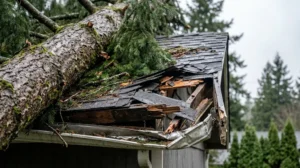
If a neighbor’s tree leans precariously over your roof, driveway, or garage, you should never take matters into your own hands with a chainsaw. Follow this legal protocol to protect your property and establish clear financial liability:
Step 1: Hire an ISA-Certified Arborist
Do not rely on informal visual assessments. Retain an independent arborist certified in Tree Risk Assessment Qualification (TRAQ). The arborist will evaluate:
- Root plate movement, soil heaving, or sheared anchoring roots.
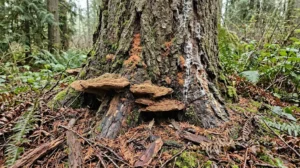
- Fungal conks, such as red ring rot (Porodaedalea pini) or velvet-top fungus (Phaeolus schweinitzii).
- Basal decay, internal trunk cavities, or severe target risks.
The arborist will compile a written Tree Risk Assessment confirming whether the tree poses an active, structural hazard to your home.
Step 2: Deliver Formal Written Notice via Certified Mail
Under Washington law, a fallen tree during a severe storm is treated as an “Act of God,” meaning your own insurance company pays for your home repairs while the neighbor owes nothing.
However, this rule changes entirely if the tree was a known hazard. Once a property owner receives formal notice that their tree is structurally compromised and fails to act, they become legally negligent.
Send a copy of the arborist’s risk assessment to your neighbor along with a professional letter requesting immediate hazard abatement. Send this via USPS Certified Mail with Return Receipt Requested. This paper trail eliminates your neighbor’s ability to claim ignorance in future insurance subrogation claims or court proceedings.
Step 3: Contact Kent Code Enforcement
If the leaning tree poses an immediate threat to the public right-of-way, sidewalks, or municipal easements, contact the City of Kent Public Works Department or the Economic and Community Development Division at 253-856-5454. The city possesses authority to inspect dangerous conditions and issue formal code violation notices requiring property owners to abate hazardous vegetation.
Local Soil Conditions and Fall Windstorms in Kent
Leaning trees in South King County carry heightened mechanical failure risks due to local terrain and regional weather patterns:
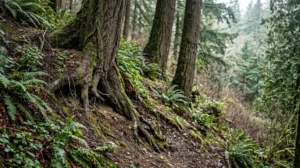
- High Water Tables in the Valley: Properties throughout the Green River Valley floor feature shallow root systems due to high seasonal water tables. Conifers in these zones lack deep taproots and rely on broad, shallow root plates that lose anchoring friction when winter rains saturate the soil.
- Steep Slope Instability: Neighborhoods along the Kent East Hill ravines and West Hill bluffs feature glacial outwash sand over compact till. Saturated hillside soils combined with asymmetrical trunk leans significantly elevate landslide and root-shear probabilities.
- Puget Sound Wind Events: Late-autumn atmospheric rivers and windstorms regularly bring wind gusts between 45 and 60 mph. A conifer with a heavy directional lean over an adjacent roofline presents severe failure risks during these seasonal storms.
Resolve Neighbor Tree Concerns Safely and Legally
Handling an encroaching or hazardous tree requires balancing strict municipal codes, state property statutes, and precise tree care practices. If an overhanging or leaning tree threatens your home, boundary fence, or yard in South King County, visit our contact page to schedule a professional on-site evaluation, structural risk assessment, and code-compliant trimming plan with Kent Tree Removal.