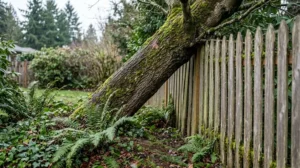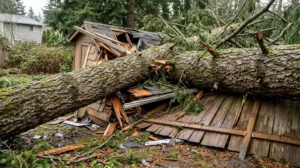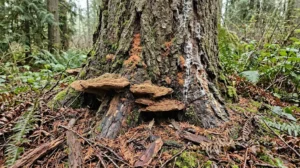
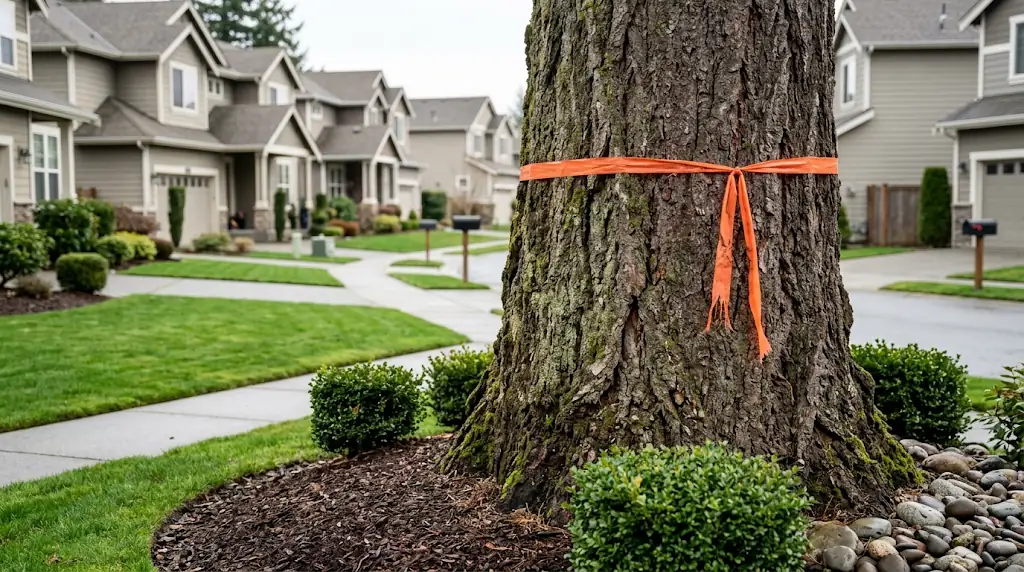
No, a Kent, WA Homeowners Association (HOA) cannot legally force you to keep an active, documented hazard tree that poses an imminent threat to life or property. While HOAs possess broad architectural control over landscaping aesthetics under their Covenants, Conditions, and Restrictions (CC&Rs), common-law negligence doctrines and municipal safety codes override private association bylaws when an ISA-certified arborist verifies that a tree is structurally compromised.
An HOA board that blocks the removal of a certified hazard exposes the association and its individual directors to direct negligence claims if the tree fails and causes structural damage or personal injury.
HOA Authority vs. Legal Safety Protections in Kent
Understanding the boundary between an HOA’s aesthetic control and a homeowner’s legal right to abate hazards is essential before starting any tree project.
| Dispute Scenario | Who Holds Final Authority? | Governing Rule / Legal Basis | Standard Resolution & Required Steps |
| Documented Imminent Hazard Tree | Homeowner | Common Law Duty of Care (Lewis v. Krussell) | ISA TRAQ Arborist report submitted to board; emergency removal proceeds. |
| Healthy Mature Tree (Aesthetic Removal) | HOA Board / Architectural Committee | Association CC&Rs / Bylaws | Architectural Review Committee (ARC) application required; board can deny. |
| Tree in Critical Area / Steep Slope | City of Kent (Preempts HOA) | Kent City Code Chapter 11.06 | Municipal Critical Area Permit required; city environmental codes override HOA rules. |
| Tree Crossing HOA Common Element Line | Shared / HOA Board | Boundary Property Law / CC&Rs | Board and homeowner must reach mutual written agreement prior to felling. |
| Dead Conifer Threatening Neighbor’s Roof | Homeowner (Duty to Act) | Washington Tort Liability | Homeowner must remove hazard to avoid willful negligence and personal liability. |
| Unauthorized Removal of Healthy Tree | HOA Board | CC&R Schedule of Fines | HOA may assess fines, mandate mature replacement planting, or seek injunctions. |
Why Common Law and City Safety Codes Override HOA Rules
Many residential subdivisions across Kent—including neighborhoods along East Hill, Lake Meridian, Benson Hill, and the Meridian Valley Country Club corridor—are governed by strict architectural review boards. However, an HOA’s authority ends where immediate life safety begins.
1. Landowner Duty of Care (Lewis v. Krussell)
Under established Washington State tort law (Lewis v. Krussell, 2000), a property owner who has actual or constructive knowledge of a defective condition affecting their trees maintains an affirmative legal duty of reasonable care to eliminate the hazard before it inflicts harm on adjacent properties.
If your Douglas fir develops root rot or structural trunk cracks, you have a legal duty to remediate it. An HOA cannot contractually compel a homeowner to violate state tort law by maintaining an actionable private nuisance.
2. Municipal Safety Preemption
City building codes and public safety regulations supersede private covenants. The City of Kent prioritizes public safety and structural integrity over private aesthetic agreements. If a dead or failing conifer leans toward high-voltage utility lines, a public roadway, or an occupied residence, municipal hazard mitigation mandates take priority over standard 30-day HOA architectural approval timelines.
3. The HOA’s Board Liability Exposure
When an Architectural Review Committee (ARC) arbitrarily denies a tree removal request accompanied by an ISA Tree Risk Assessment Qualification (TRAQ) report, the association assumes severe legal exposure.
- By denying the removal of a documented hazard, the HOA actively interferes with hazard abatement.
- If that tree subsequently collapses during a Puget Sound windstorm, the association can be named as a co-defendant in civil litigation for negligence and property damage.
- Most HOA Directors and Officers (D&O) insurance policies specifically exclude coverage for intentional torts or deliberate failures to remediate known hazards.
When Can an HOA Legally Block Tree Removal?
An HOA board operates entirely within its legal rights under the following conditions:
- The Tree Is Structurally Sound: If a homeowner simply dislikes raking needles, wants more sunlight for a lawn, or seeks to install a patio, the HOA’s architectural authority governs. If an arborist report confirms the tree is healthy with low failure risk, the board can deny the removal permit based on community canopy standards.
- Failure to Submit Proper Architectural Forms: Even in urgent scenarios, homeowners are contractually obligated to follow association notice procedures. Cutting a tree down without notifying the board or submitting the required emergency notification paperwork will trigger fines, even if the tree was diseased.
- Failure to Comply with Replanting Covenants: Most Kent HOAs maintain canopy replacement rules. CC&Rs frequently require property owners who remove an approved tree to plant an approved replacement specimen (such as an ornamental maple or native dogwood) within 30 to 90 days. The board cannot force you to keep the hazardous tree, but it can force you to plant an approved alternative.
- The Tree Sits on Common Property: If the tree is rooted on an HOA greenbelt, community trail corridor, or shared slope behind your fence, you do not own the tree. You cannot unilaterally hire a tree service to cut timber on common property. You must formally petition the HOA board to remove the dangerous tree at the association’s expense.
Step-by-Step Protocol to Override an HOA Tree Denial
If your HOA board hesitates or denies your request to remove a dangerous tree, follow this defensible documentation process:
Step 1: Retain an ISA-Certified TRAQ Arborist
Do not submit general contractor estimates or subjective opinions to your board. Hire an independent arborist certified in Tree Risk Assessment Qualification. The arborist will measure:
- Root flare integrity and fungal pathogen activity (such as Phaeolus schweinitzii or Coniferiporia sulphurascens).
- Structural shell thickness using sound-testing mallets or micro-resistance drilling.
- Crown asymmetry, deadwood percentage, and target proximity to occupied structures.
The arborist drafts a formal, standardized Tree Risk Assessment concluding with an explicit risk rating (Imminent, High, Moderate, or Low).
Step 2: Submit an Emergency Notice via Certified Mail
Submit your HOA Architectural Review application accompanied by the TRAQ report. If the risk rating is High or Imminent, send the packet via USPS Certified Mail with Return Receipt Requested and via direct email to the board president and property manager.
Include an explicit statement in your cover letter:
“Attached is an ISA TRAQ hazard report identifying this tree as an imminent structural safety threat. Denying this abatement transfers liability for all subsequent structural damages, personal injuries, and insurance subrogation claims to the association.”
Step 3: Verify City of Kent Critical Area Exemptions
If your home borders steep ravines along the East Hill or wetland buffers near Soos Creek, check the City of Kent Land Use & Environmental Regulations. Secure city hazard validation if your property falls within an Environmentally Critical Area (ECA). A municipal permit or critical-area exemption notice provides indisputable proof that overrides any remaining HOA objections.
Step 4: Proceed with Emergency Removal
Once formal notice is delivered and the hazard is documented by both an arborist and local code parameters, execute the removal. If the HOA attempts to levy an administrative fine, provide the complete certified paper trail to the board’s legal counsel. HOA attorneys routinely direct boards to rescind fines when faced with formal TRAQ hazard documentation.
Local Factors Driving Tree Hazards in Kent Subdivisions
Kent’s unique geography and tree composition create distinct risks in master-planned HOA developments:
- Subdivision Clearing and Wind Exposure: Many East Hill and Panther Lake subdivisions were carved out of dense, native conifer forests. When developers clear parcels, remaining Douglas firs and Western hemlocks lose the collective buffering of a closed forest canopy. These newly exposed “edge trees” are vulnerable to sudden windthrow during 50 mph Puget Sound winter windstorms.
- Shallow Root Plates Over Compacted Subsoil: Suburban grading compacts glacial till and creates shallow topsoil layers. Conifers in these developments develop broad, flat root plates that cannot penetrate compacted hardpan, increasing tip-over risks when heavy rains saturate local soils.
- Aging Pioneer Species: Many older subdivisions built in the 1980s and 1990s feature mature red alders (Alnus rubra) and European white birches (Betula pendula). These fast-growing species have natural lifespans of only 40 to 60 years and are now reaching advanced decay, shedding large limbs into HOA common yards and private rooflines.
Remove Hazardous Trees with Full Code and HOA Compliance
Safely removing a dangerous tree while managing HOA architectural guidelines requires rigorous arborist documentation, meticulous site planning, and complete municipal compliance. If an overgrown, rotted, or leaning tree threatens your home in South King County, get in touch through our contact page to schedule an ISA-certified hazard risk assessment and fully compliant removal with Kent Tree Removal.